XRP Holds $1.41 as Bulls Eye the $1.45 Resistance Wall
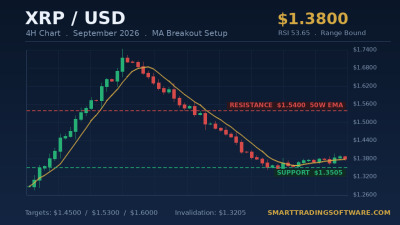
Ripple's XRP is grinding through one of its tightest consolidation phases of 2026. After several weeks of price action wedged between the $1.38 floor and the $1.45 ceiling, the token is now sitting at $1.41 with traders watching the next move closely. The 14-day RSI sits at 41.26 — neutral but tilted toward weakness — while the MACD remains negative on the daily chart. The 200-day moving average at $1.4238 has become the line in the sand: a clean push above it opens the door to $1.55 and beyond, while a failure to defend $1.30 risks a slide toward $1.20.
What makes this setup interesting isn't the price itself — it's the structure. XRP has been printing higher lows since late March while running into the same descending supply at $1.45. That kind of compression typically resolves with a violent expansion. The U.S. spot XRP ETF complex has pulled in a record $1.29 billion in cumulative inflows, and April alone added $83.83 million in net buying — the strongest month of the year. The fundamentals are quietly stacking up; the chart is waiting.
Why a Renko Strategy Fits XRP Right Now
Renko charts strip out time and noise. Each brick only prints when price moves a fixed amount, so the choppy intraday whipsaws that wreck candlestick traders simply don't exist on a Renko chart. For an asset like XRP — where intraday swings often look chaotic but the larger structure is clean — this filter is exactly what a systematic trader needs.
The Renko Bot automates this approach on MetaTrader 4 and MetaTrader 5. It draws Renko bricks in real time, recognises trend shifts, and only opens positions when a configurable number of consecutive bricks confirms direction. Because XRP's $1.38–$1.45 range has been tested at least seven times in the last three weeks, a fixed-brick confirmation system filters out the false breakouts that have trapped discretionary traders repeatedly.
Brick Size and Confirmation Settings
For XRP at this volatility, a brick size of $0.005 (0.5 cents) on the 1-hour basis offers a workable balance — large enough to ignore micro-noise, small enough to catch a legitimate breakout early. Three consecutive bricks in the same direction is the standard confirmation threshold; four for traders who prefer fewer false signals.
Entry, Stop, and Target Logic
A long entry triggers when three green bricks close above the $1.4238 200-day MA — that is the technical bull line, and a confirmed move through it changes the structure. Initial stop-loss sits at $1.385, just below the recent swing low, giving roughly $0.025 of risk. The first target is $1.45 (the descending resistance), the second is $1.485, and the runner targets the $1.55 May projection from CoinDCX and similar models. On the short side, a confirmed three-brick close below $1.385 opens a setup targeting $1.32 and then $1.22 — invalidation goes back above $1.42.
Automation Cuts the Decision Fatigue
The biggest enemy of a range-trader is hesitation. By the seventh test of the same level, every false breakout has trained the discretionary trader to wait one more candle — and that's exactly when the real breakout happens. Automating with the Renko Bot removes the hesitation. The brick logic is mechanical: three bricks, position opens; opposite brick prints, exit triggers. There's no room for "this time it's different."
For traders who want to validate the approach before going live, the Indicators Tester lets you replay any indicator-driven strategy on historical XRP data. Drop the Renko Bot logic onto six months of 2025–2026 XRP price action and you can measure exactly how the brick size and confirmation count would have performed across the consolidation, the February drawdown, and April's ETF-driven recovery. Backtesting before live deployment is not optional in this market — it's the difference between a trader and a gambler.
Key Levels to Watch This Week
The map for the coming sessions is unusually clear. Immediate resistance sits at $1.4238 (200-day MA), with stronger supply at $1.45. A close above $1.45 unlocks $1.485 and then $1.55, the May 2026 consensus target. To the downside, $1.385 is the first defence; lose it and $1.35 comes quickly into play, with $1.30 as the make-or-break floor. Below $1.30 the structure breaks and $1.22–$1.20 becomes the next demand zone.
Volume tells the story. A breakout through $1.45 on rising volume is the trade; a breakout on flat volume is a fade. The Renko Bot doesn't read volume directly, but it does ignore the low-volume drift that usually accompanies fakeouts — bricks only print when real price movement happens.
Getting Started With the Renko Bot on XRP
- Open or fund a MetaTrader 4 or MetaTrader 5 account with a broker that offers XRP/USD CFD or spot pairs.
- Purchase and install the Renko Bot from the Smart Trading Software catalogue.
- Set brick size to $0.005, timeframe to H1, confirmation bricks to 3, and risk per trade to 1% of equity.
- Backtest the configuration on 6+ months of XRP data using the Indicators Tester before going live.
- For range-bound entries, pair the bot with the Support & Resistance Bot to add level-based confirmation around $1.385 and $1.45.
- Run the strategy on a demo account for at least 10 trading days before allocating real capital.
XRP's compression won't last. When the $1.38–$1.45 range finally resolves, the move could be sharp in either direction — and a systematic trader with the right automation in place is the one who captures it instead of chasing it. If you'd like a walkthrough of configuring the Renko Bot for XRP or any other crypto pair, the team at Smart Trading Software is one click away on the contact page.