DAX 40 Tests Channel Resistance Near 24,200 With RSI in Buy Zone
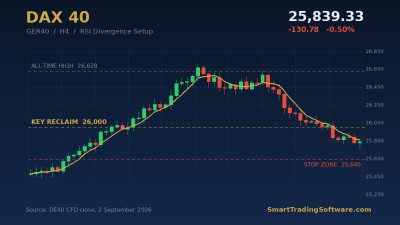
The German DAX 40 has spent the past two weeks consolidating inside a descending channel after rejecting from the May 6 swing high near 25,100. Frankfurt's benchmark closed at 23,950 on May 15 following a 2.07% session decline, but buyers have since stepped back in as price reclaimed the 50-day simple moving average at 24,086. With the 5-day SMA now at 24,184 and price hovering directly on this short-term trend gauge, the index sits at an inflection point that will likely decide whether bulls retake control or sellers push for another test of the 23,800 medium-term floor.
The 14-period RSI is currently printing 63.12, firmly inside the buy zone but inching toward overbought territory. The MACD histogram has ticked positive in early May sessions, confirming that short-term momentum is rebuilding from neutral. However, with the index still sitting roughly 1,300 points below the January 13 all-time high of 25,507.79, traders need to decide whether to fade the channel resistance or position for a momentum breakout through the upper channel boundary near 24,500.
How to Trade the DAX 40 Channel Break With RSI Divergence
The setup that matters most here is a confirmed RSI divergence at the channel boundary. If price punches through 24,500 while RSI fails to make a corresponding higher high, that bearish divergence becomes a high-conviction short signal at a known resistance shelf. Conversely, if the index respects the upper channel and rolls over without RSI even reaching overbought, momentum traders can position for a return to channel support around 23,920 with tight risk.
Bullish Setup Parameters
Entry trigger: H4 close above 24,500 with RSI above 65 and no bearish divergence between price and oscillator. Confirmation comes from a retest of the broken channel boundary that holds. Stop-loss sits below the 50-day SMA at 24,050 to give the trade room to breathe. First take-profit at 24,887 (the May 7 intraday range high), with a runner targeting the 25,100 swing high and ultimately the 25,507 all-time high if momentum extends.
Bearish Setup Parameters
Entry trigger: H4 close below 24,050 with RSI rolling below 50 and MACD histogram flipping negative. Stop-loss above 24,310 to invalidate on a recovery of the 100-day SMA at 24,282. First take-profit at 23,921 (classic pivot), with a runner targeting the 23,800 medium-term support floor. A decisive break below 23,800 opens the door for a deeper retracement into the 23,400-23,500 demand zone where macro buyers have historically defended.
Why Automation Matters for DAX RSI Divergence Setups
RSI divergence on the DAX is notoriously difficult to trade manually because it requires monitoring price action and the oscillator on multiple timeframes simultaneously while waiting for the confirmation candle. By the time a discretionary trader spots a clean H4 divergence, the optimal entry has often already moved 20-40 points against them. The RSI Divergence Bot automates this entire process by scanning for bullish and bearish RSI divergences across configurable timeframes and triggering entries the moment confirmation prints. The bot ships preconfigured for indices like the DAX 40 and includes adjustable RSI period, divergence lookback, and risk-per-trade parameters.
For traders who prefer trend-following strategies on indices during clearer directional phases, the Trend Lines Bot handles channel breaks and trendline rejections automatically. It maps the descending channel structure visible on the DAX H4 and submits orders only when price closes outside the channel with volume confirmation. It pairs naturally with the RSI Divergence Bot to cover both reversal and continuation scenarios.
Key DAX 40 Levels to Watch This Week
Above price: 24,282 is the 100-day SMA shelf, followed by 24,500 as the descending channel upper boundary. 24,887 marks the May 7 intraday high and 25,100 caps the May 6 swing high. The all-time high at 25,507 remains the major upside magnet, with the round 26,000 level acting as psychological resistance beyond that.
Below price: 24,086 is the 50-day SMA, with 24,050 acting as the bull/bear pivot. 23,950 was the May 15 close and 23,921 is the classic pivot point. The 23,800 medium-term support is the key floor; a daily close beneath it would shift the technical bias decisively bearish and open 23,400-23,500 as the next demand zone.
Getting Started With the DAX 40 RSI Divergence Setup
- Open your MT4 or MT5 platform and load the GER40 or DAX40 symbol on the H4 timeframe.
- Install the RSI Divergence Bot on the chart and configure RSI period to 14, divergence lookback to 30 bars, and risk-per-trade to 1%.
- Optionally attach the MA Distance Indicator to monitor price extension from the 50-day and 100-day moving averages, which is useful for filtering low-quality divergence signals.
- Backtest the configuration on the last 12 months of DAX H4 data using the Indicators Tester before deploying to live capital.
- Enable the bot and let it monitor for divergence confirmation around the 24,500 channel resistance and 23,800 support floor.
The DAX is at a clean technical decision point with measurable risk on both sides of the channel. Whether you lean bullish on the momentum rebuild or bearish on the divergence setup, automation removes the emotional friction that typically erodes returns on indices with this level of two-way volatility. Reach out via our contact page for help configuring the RSI Divergence Bot for your specific DAX broker feed and account size.