XRP Coils Beneath $1.47 Resistance as Mid-May 2026 Range Tightens
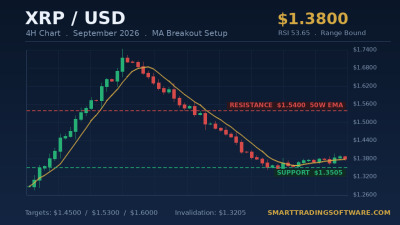
Ripple (XRP/USD) is trading near $1.463 in mid-May 2026, holding inside a tight $1.40–$1.47 range that has now defined price action for the better part of three weeks. The $1.45–$1.47 supply zone has rejected XRP four separate times this year, and last week's brief poke above $1.50 was met by immediate profit-taking that pulled price back into the middle of the range within hours. Below, the 100-hour moving average is acting as a soft floor around $1.44, while the 200-day moving average sits a touch higher near $1.4238 and continues to flatten as the consolidation matures.
The wider technical backdrop remains finely balanced. The monthly RSI prints around 45, the MACD is hovering just under the zero line with a contracting histogram, and the SMA50 keeps trading above price – classic signs of a market that has digested its decline from $1.80 but has not yet decided which direction to break. With the CLARITY Act in US Senate markup and ETF flows still drifting positive, the trigger for the next leg is almost certainly going to come from outside the chart. The job of an active trader, therefore, is not to predict that catalyst but to be positioned for whichever side gives first – and that is exactly what a structured support and resistance approach is built for.
Why a Support & Resistance Bot Fits XRP Right Now
Ranging instruments punish trend-followers and reward traders who fade levels until those levels break. XRP has spent more time inside well-defined boxes than in trends over the past two years, and the current $1.40–$1.47 box is no exception. A rules-based S&R framework turns the obvious zones on the chart into actionable orders: sell-limits stacked into resistance, buy-limits parked at support, with stops sized to the depth of each zone rather than to gut feel. The setup also handles the moment the range fails, flipping the broken level into the opposite role and re-arming.
Defining the Working Zones
For this week, the relevant zones on the 4-hour chart are clear. Resistance Zone 1 sits at $1.460–$1.475, with the upper edge defended by the rejection wicks from May 6, May 9 and May 12. Resistance Zone 2 lies at $1.500–$1.515 and aligns with the volume shelf left from the late-April decline. On the downside, Support Zone 1 covers $1.420–$1.440 (where the 200-day MA and 100-hour MA converge), and Support Zone 2 covers $1.380–$1.395 – the swing low pivot that produced the bounce on May 5.
Entry, Stop and Target Parameters
Inside the range, the playbook is to fade the edges. A short trigger fires on a 4-hour close back inside $1.475 after a wick above, with a stop above $1.495 and an initial target at $1.440 (roughly a 1.6R move). A long trigger fires on a 4-hour close back above $1.420 after a wick into the lower zone, with a stop below $1.395 and a first target at $1.460. Breakout mode activates only on a clean daily close above $1.475 with above-average volume – in that case the bot flips bias, treats $1.460–$1.475 as new support, and targets the $1.500 and $1.555 levels toward the longer-term $1.80 objective. A confirmed daily close below $1.395 mirrors the logic on the short side, opening room to $1.35 and then $1.20.
Where Automation Earns Its Keep on a Range Like This
The hardest part of trading a range that has already rejected four times is staying disciplined on the fifth attempt – the moment when it usually does break. Automation removes that hesitation. Our Support & Resistance Bot reads user-defined zones, places pending orders at the edges with pre-calculated lot sizing, and manages stops, partials and trailing exits without intervention. For traders who prefer to combine the level-based logic with a momentum filter, the RSI Divergence Bot can act as a second confirmation layer, taking trades only when momentum is diverging from price at the edge of the zone – a particularly useful tool on XRP, which has produced clean RSI divergences at both range extremes in recent weeks.
For users who want to map levels visually before letting the EAs handle execution, the Support & Resistance Indicator plots dynamic zones across multiple timeframes and feeds the same coordinates the bots read. Before risking live capital on any of this, the Indicators Tester lets you replay the last six months of XRP price action bar-by-bar and validate that your zone widths and stop placement actually survive contact with real volatility.
Key Levels to Watch This Week
The lines in the sand for the coming five trading sessions are tight and worth marking on the chart in advance. Immediate resistance: $1.475, then $1.500, then $1.515. Immediate support: $1.440, then $1.395, then $1.350. Bullish trigger: a 4-hour close above $1.475 with rising volume, opening $1.500 first and $1.555 as the measured-move target. Bearish trigger: a 4-hour close below $1.395, which would invalidate the multi-week base and bring $1.350 and $1.200 into play. The 200-day MA at $1.4238 remains the single most important level – price closing back above it on a daily basis is the first piece of evidence that buyers are regaining control.
Getting Started with the XRP Range Setup
To translate this analysis into orders on your own MT5 chart, work through the steps in order rather than skipping ahead. First, open XRP/USD on the 4-hour timeframe and mark the four zones described above as horizontal price ranges, not single lines. Second, install the Support & Resistance Indicator to keep those zones updated automatically as price prints new swing highs and lows. Third, deploy the Support & Resistance Bot on a demo account with the zone coordinates and stop distances from the section above – never live-trade a configuration you have not first watched run for at least a week of session data. Fourth, run a parallel backtest in the Indicators Tester using the last 90 days of XRP data to see how the same parameters would have handled the late-April breakdown and the early-May recovery; that exercise alone is usually enough to expose any stop that is too tight. Fifth, only after demo and backtest results align with expectations, scale the position size up gradually on a live account.
XRP's current compression is unusually clean and the levels are unusually well-defined, but ranges break eventually – and the trader who is mechanical about both fade entries inside the box and breakout entries outside of it captures both halves of the move. If you want help configuring any of the tools mentioned above for your account size, broker or risk profile, get in touch via our contact page and our team will walk through the parameters with you.