Bitcoin Stalls Near $76,343 as the $80K Breakout Test Approaches
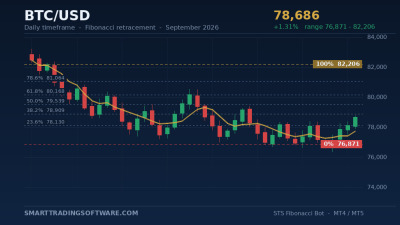
Bitcoin is grinding through a tight consolidation in the upper $75,000s after a volatile three-week corrective phase that pulled price down from the October 2025 highs near $126,000. As of late May 2026, BTC/USD is hovering around $76,343, with the 30-day moving average doing the heavy lifting as dynamic support, and the broader $73,000–$75,000 zone acting as the line in the sand for the bulls.
The setup matters because three confluences sit stacked on top of each other right above current price: the $80,000 round number, the upper edge of the recent consolidation, and the trigger zone where algorithmic models such as the ones tracked by CoinDCX and Intellectia.ai project a high-probability close by month-end. A clean reclaim of $80,000 with sustained volume opens the door to the $85,000–$90,000 supply pocket, where the next real seller layer lives.
Why the $76,343 Zone Is a Critical Inflection Point
The $73,000–$76,000 band is doing more than just acting as recent support. It overlaps with the 50-day exponential moving average, the 0.618 Fibonacci retracement of the leg from the May low, and the volume profile’s point-of-control for the entire May range. When three independent measurements land on the same area, that is exactly the kind of structure mean-reversion and breakout strategies feed on.
RSI on the 4-hour chart is sitting just above 38 and the daily RSI dipped into the high 20s on the last leg lower before snapping back. Oversold readings on a major asset like BTC are rarely the end of the move, but they almost always precede the kind of two-way price action that algorithmic systems are designed to exploit. The MACD is still beneath its signal line on the daily, but the histogram has started to flatten — the classic precursor to a momentum cross.
The $80K Breakout Trade: Entry, Exit, Stop, and Targets
This is a mechanical setup, not a guessing game. The plan is to fade neither side of the $76,343 pivot but to wait for the market to commit, then ride the move with predefined risk.
Entry Trigger
The long entry activates on an hourly close above $80,150, which clears both the psychological $80K level and the May 14 swing high. Aggressive traders can use a stop-buy at $80,250 to avoid waiting for the bar to close. A short version of the same trade triggers on an hourly close below $73,000, which would break the consolidation floor and put $70,000 directly in play.
Stop Loss
Initial protective stop for the long sits at $78,400, just under the most recent intraday higher-low and below the 4-hour 200-EMA. That is roughly 2.2% of risk per unit, which keeps R-multiple math clean for position sizing.
Take Profit Levels
First scale-out at $83,500 — the upper boundary of the prior April distribution. Second target sits at $87,200, the volume gap left behind during the October push. A trailing stop using the 4-hour Chandelier exit or a fixed 3x ATR(14) handles the runner toward $90,000 if momentum keeps building.
Why Automation Beats Discretion at $80K
Round-number breakouts are the single most common spot where discretionary traders give back their edge. Liquidity gets sucked toward $80,000 by stop-runs from both sides, spreads widen for thirty to ninety seconds, and the immediate retracement after the first burst is fast enough that human reaction time alone is the difference between a winning fill and a stopped-out one. An execution bot does not flinch when the candle wicks.
The Crypto Bot is built for exactly this kind of regime. It monitors BTC, ETH, SOL and other majors on lower timeframes, applies a volatility-filtered breakout logic, and only fires once the close-and-confirm rule is satisfied. Position sizing is automatic, stop-loss is bracketed at order time, and partial take-profits are layered without manual intervention. For traders who prefer a structurally different approach to the same chart, the Renko Bot strips out time entirely and triggers only on completed price bricks — a clean way to filter out the chop that usually surrounds a $80K test.
Before committing real capital to any breakout system, it is worth running a structured forward and backward pass on the recent BTC tape. The Indicators Tester lets you replay the May 2026 price action bar-by-bar against any combination of RSI, MACD and ATR parameters, so the bot you deploy is calibrated to the current regime rather than to last cycle’s.
Key Levels to Watch This Week
The trade plan only stays valid as long as the structure holds. The levels below are the ones to mark on the chart and the alerts to set in advance:
Resistance: $80,000 (psychological + range high), $83,500 (prior distribution top), $87,200 (volume gap), $90,000 (next round number and likely FOMO trigger), $100,000 (six-figure resistance and 2026 line-in-the-sand).
Support: $76,343 (MA-30), $75,000 (range mid), $73,000 (consolidation floor and 50-day EMA), $70,000 (psychological), $68,900 (uptrend bottom), $65,000 (deep safety net).
A daily close below $73,000 invalidates the bullish breakout thesis and puts the short side of the same setup in play, targeting the $70,000 then $65,000 zones.
How to Get Started with the Setup
The path from reading this analysis to having an automated system on the chart is short if you take it in order:
1. Open BTC/USD on the 1-hour and 4-hour charts in MetaTrader 4 or MetaTrader 5 and mark the $76,343, $80,000 and $73,000 levels.
2. Install the Crypto Bot on a demo account and configure the breakout filter to the $80,150 trigger and $78,400 stop described above.
3. Run a parallel backtest pass on the same parameters using the Indicators Tester across the last 90 days of BTC data to confirm the win-rate and average R holds up in the current volatility regime.
4. If the Renko approach fits your style better, swap in the Renko Bot and let the brick size do the noise filtering for you.
5. Move to a live account only after the demo has produced a statistically meaningful sample — thirty trades minimum is a useful floor.
If you would like help calibrating any of these tools to your account size, broker, or preferred risk profile, the desk is happy to talk it through — reach out via the contact page and we will get back to you the same business day.