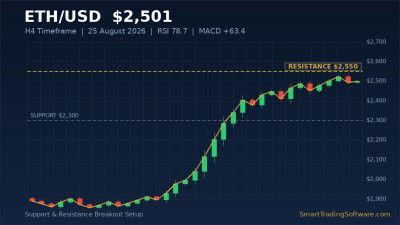
BNB Holds Above $660 Support as $710 Resistance Looms in Mid-May 2026
Binance Coin (BNB/USDT) is trading near $682 in mid-May 2026, consolidating in a tight band beneath the $710 resistance that has capped every advance since late April. After a steady five-week climb from the $620 area, BNB has carved out a higher-low structure with the 20-, 50-, 100- and 200-day exponential moving averages all stacked bullishly below price — a configuration that often precedes a continuation move, but only if buyers can reclaim the $710 ceiling on a daily close. The 14-day RSI is hovering around 58, well shy of overbought territory, while the MACD on the daily chart has just flipped positive after a long flat stretch. Volume has been muted during the consolidation, which is typical of coiled-spring setups but also makes the next breakout candle critical for confirming follow-through.
What makes this configuration interesting for systematic traders is the symmetry of the levels. The $660 zone has been defended four times in the past three weeks and now aligns with the 50-day EMA, giving bulls a clear line in the sand. Above, $710 represents not just horizontal resistance but the 0.618 Fibonacci retracement of the February-to-April correction. A clean break opens the door to the $760–$810 supply pocket that capped BNB through Q1, and end-of-May projections from major desks cluster around the $715 area, suggesting the market is already pricing in some upside.
Trading the $710 Breakout on BNB
The setup divides cleanly into two playbooks: a breakout long above $710, and a fade short on a failed retest that confirms the range cap. Both lean on the same structural levels, just on opposite sides of the trigger. The key is letting price tip its hand — chasing inside the $660–$710 chop will only generate whipsaw fills.
Breakout Entry Parameters
The cleanest long trigger is a 4-hour close above $712 with above-average volume, followed by a pullback into the $708–$710 retest. Aggressive traders can ladder in on the break itself with a tight stop, but the retest entry offers a far better risk-to-reward profile. Initial stop sits below $695, just under the previous swing high that now flips to support on a successful breakout. Position size should reflect that BNB has averaged 3.7% daily range in May, so a 1.5R stop is meaningful.
Take-Profit Ladder and Trailing Logic
First profit target is $740, which scales out roughly one-third of the position and locks in a 4R move from the retest entry. The second tranche unloads at $760, the lower edge of the Q1 supply pocket, and the runner trails behind the 4-hour 20-EMA toward the $810 measured-move objective. If price stalls between $740 and $760 with bearish divergence on the hourly RSI, the runner should be tightened to a structural stop under the most recent 4-hour swing low rather than waiting for the EMA to catch up.
Invalidation and the Short Side
The bullish thesis is invalidated on a daily close below $660. That break would expose $630–$645, the rising-trendline confluence and the next high-volume node on the daily profile. Short setups make sense on a retest of $660 from below with bearish 1-hour structure, targeting $645 then $620, with a stop above $672.
Why Automation Beats Manual Execution on This Setup
Consolidation breakouts punish hesitation. The most reliable BNB breakouts of the past year resolved during low-liquidity hours — late US session and early Asia — when manual traders are typically away from screens. An algorithmic execution layer removes that timing risk entirely. Our Crypto Bot ships with configurable breakout logic, volume filters, and automated invalidation handling for exactly this kind of compressed-range setup on MetaTrader 5. Once the user defines the $710 trigger, $695 stop, and the $740/$760/$810 take-profit ladder, the bot manages entries, scales, and trailing logic without emotional drift.
For traders who prefer to read momentum confirmation rather than pure price action, the RSI Divergence Bot adds a second layer of filtering by waiting for hidden bullish divergence on the lower timeframes before opening longs — useful for reducing false breakouts when daily volume is thin. Either bot can be paired with the Support & Resistance Bot to fade the range while the breakout setup is still pending, which produces a more capital-efficient deployment during the wait.
Key BNB Levels to Watch This Week
Resistance to track from current price: $710 (range cap and 0.618 retracement), $740 (first measured-move target), $760 (lower edge of Q1 supply), and $810 (upper end of the supply pocket). On the downside, watch $672 (intraday pivot), $660 (50-day EMA and four-touch range floor), $645 (rising-trendline support), and $630 (high-volume node). The 14-day RSI breaking above 65 on the daily would confirm momentum follow-through on a breakout; if RSI rejects from the 62–63 zone instead, expect another range trip toward $660 before the next attempt.
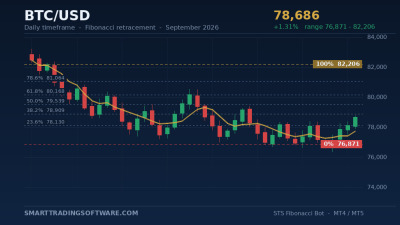
One context note worth flagging: BNB tends to follow Bitcoin's directional bias but lead on percentage moves during ecosystem-driven catalysts. With BTC consolidating in its own $76,000–$83,000 range, BNB's $710 trigger may well coincide with a broader-market resolution. Cross-checking the BTC chart at the moment of breakout is a worthwhile final filter.
Getting Started With Automated BNB Trading
Here is a practical sequence for putting this setup into production:
- Backtest the breakout logic on BNB's last six months of MT5 data using the Indicators Tester to validate trigger sensitivity and the volume filter threshold.
- Deploy the Crypto Bot on the daily and 4-hour charts with the $710 trigger, $695 stop, and the three-tranche TP ladder described above.
- Layer in the Support & Resistance Bot for range scalps inside $660–$710 while the breakout signal is pending, sizing it at roughly 25% of the breakout allocation.
- Enable cross-asset risk caps so the combined BNB exposure across both bots cannot exceed your per-instrument limit.
- Review fills weekly and adjust the trigger band by 1–2 ATR if BNB's daily range expands beyond the 3.7% baseline.
Have questions about pairing the Crypto Bot with another instrument, or want help calibrating the breakout filter for your account size? Reach out via the contact page and we will walk through the configuration with you.