DAX 40 Trades Near 24,292 as Bulls Eye the 25,500 January High
Germany's flagship index has been carving out a constructive base around the 24,000 psychological level, with the DAX 40 currently changing hands near 24,292 after a strong 1.4% session that lifted the benchmark off recent lows. Heavyweights such as Deutsche Post, Bayer and Brenntag led the rebound, and the daily moving-average matrix has flipped back to a Strong Buy reading. With the 52-week high of 25,507.79 set on January 13, 2026 still in play, traders are now watching whether bulls can muster the momentum to retest that ceiling, or whether the index needs to digest gains around the 24,000-24,500 accumulation pocket first.
The medium-term backdrop remains supportive: ECB easing expectations, resilient German earnings and a recovering export cycle continue to underpin the index. Technically, the DAX is sitting just above a multi-month accumulation zone between 23,000 and 24,500, and a clean weekly close above 24,500 would put the 25,500 resistance and the 26,000 psychological round number squarely on the radar. For systematic traders, that is exactly the kind of environment where a momentum-and-reversion oscillator like the Commodity Channel Index can earn its keep.
Why the CCI Bot Fits the Current DAX Setup
The CCI was originally designed for cyclical commodities, but it has proven equally effective on equity indices that swing between trend bursts and mean-reverting consolidations - a textbook description of the DAX 40 right now. Readings above +100 flag overbought momentum, below -100 mark oversold conditions, and zero-line crosses help confirm directional shifts. Combined with horizontal pivots at 24,000, 24,500 and 25,500, those signals translate directly into actionable rules.
The challenge for discretionary traders is that the DAX often prints sharp 150-200 point intraday rotations around these levels, and reaction times matter. That is where the CCI Bot comes in: it monitors the CCI continuously across configurable lookback windows, fires entries the moment the oscillator crosses a user-defined threshold and applies a fixed risk model so emotion never enters the equation.
Entry, Exit, Stop and Target Parameters
For the current DAX structure, a balanced configuration looks like this:
Long bias setup: wait for CCI(20) on the H1 chart to dip below -100, then trigger a long when CCI crosses back above -100 with price holding the 24,000 horizontal floor. Initial stop loss sits at 23,880, ten ticks below the recent swing low. First take-profit at 24,500 (1:2 reward-to-risk), second target trailing toward 25,000.
Short bias setup: if CCI(20) on H1 climbs above +200 in proximity to the 25,500 January high without a clean break, the bot can stage a counter-trend short on the cross back below +100. Stop loss above 25,560, first target 25,000, second target 24,500.
Position sizing should respect a 0.5%-1% account risk per trade. The DAX cash index typically demands a 60-90 point hard stop on H1 and 30-40 points on M15, so the lot calculator inside the bot should be configured accordingly.
Automation Removes the Two Biggest DAX Trading Mistakes
Reviewing forum and broker statistics on European-session traders, two errors recur with alarming consistency: skipping setups during the cash-open volatility burst at 09:00 CET, and over-trading the lunchtime drift. A bot does not blink during the open and does not get bored during the doldrums. The CCI Bot can be scheduled to operate only during the high-liquidity windows (09:00-11:30 and 14:30-17:00 CET), filtering out exactly the chop where most discretionary traders bleed equity.
Pairing the bot with a confirmation indicator such as the Trend Lines Bot or a structural overlay also helps avoid taking CCI signals into the teeth of the dominant daily trend. When both modules agree - say, a CCI long signal occurring while the H4 trend line slope is positive - historical hit rates on the DAX have been materially higher than CCI in isolation.
Key Levels to Watch on the DAX 40 This Week
The map for the coming sessions is well defined:
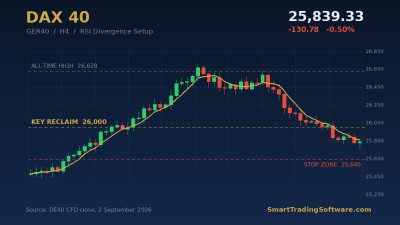
Upside resistance: 24,500 (short-term swing pivot), 25,000 (round number and prior consolidation high), 25,507 (52-week high from January 13), 26,000 (next psychological target if the breakout extends).
Downside support: 24,000 (psychological barrier and current battle line), 23,500 (mid-range pivot), 23,000 (top of the November-December accumulation), 22,943 (November 2025 swing low - the line in the sand for the broader uptrend).
A daily close above 24,500 with rising volume is the trigger that opens the door to a measured move toward 25,500. Failure to hold 24,000 on a closing basis would shift the focus back toward 23,500 and likely keep the index range-bound for several more weeks.
Getting Started With Automated DAX 40 Trading
Putting the strategy to work is straightforward:
1. Backtest first. Before risking live capital, run the CCI parameter set across at least the last 18 months of DAX data using the Indicators Tester. Focus on win rate, average R-multiple and the maximum consecutive loss streak around the August 2025 and February 2026 volatility spikes - that is where most CCI strategies break down.
2. Forward-test on a demo account. Plug the optimized configuration into the CCI Bot on a demo MT4/MT5 account for two to three weeks. Verify slippage assumptions, broker spread behaviour during DAX cash open, and the bot's session filter.
3. Go live with conservative sizing. Start with 0.5% risk per trade and the bot's news filter active during German CPI, ECB rate decisions and FOMC events. Scale risk up only after a documented edge over at least 50 closed trades.
4. Monitor and iterate. Once a month, re-run the parameter sweep against the latest data. Markets change - the CCI threshold that worked in Q1 may need a small adjustment heading into the summer.
If you are still weighing whether systematic execution is the right fit for your DAX trading, the team at SmartTradingSoftware can walk you through configuration, broker compatibility and parameter tuning. Reach out via the contact page and we will help you decide which combination of tools matches your account size and trading hours.