USD/JPY Tests 160 Ceiling as BOJ Rate Hike Bets Build
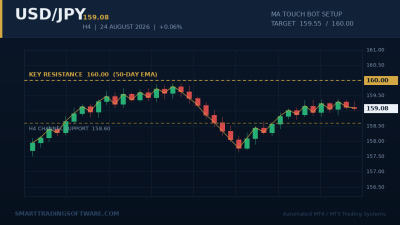
The USD/JPY pair is hovering at 158.906 on April 22, 2026, locked in a tight battle around the 20-day exponential moving average near 158.95. Price has been compressed inside a month-long sideways consolidation between the April 17 low at 157.60 and the March swing high at 160.46, with traders waiting on the next Bank of Japan policy signal before committing to a directional move.
The macro backdrop is unusually loaded. The Bank of Japan held rates at 0.75% last week, but Japanese 2-year yields have spiked to 30-year highs of 1.32% as money markets now price in a 64% probability of an April rate hike. At the same time, the dollar found a near-term bid after failed US-Iran ceasefire talks pushed oil higher and reignited safe-haven flows into the greenback. The result is a textbook coiled spring, and the March ascending trend line drawn from the late-February swing low through the early-April higher low remains the structural pivot every short-term trader is watching.
Why a Trend Lines Strategy Fits This Setup
When price action stalls inside a wedge or rising channel just below a major round number like 160.00, classic trend line trading tends to outperform oscillator-only systems. The market is essentially asking one question: does the ascending support hold for another bounce, or does a clean break trigger a retest of 156? A disciplined trend line approach answers that question with two binary triggers rather than guesswork — buy the confirmed bounce, or sell the confirmed break. No prediction required.
The Trend Lines Bot automates this process inside MetaTrader 4 and 5. It draws moving-average-based dynamic trend lines on the chart, monitors price interaction with those lines bar by bar, and fires entries the moment a confirmation candle prints. For a slow, range-bound mover like USD/JPY in April 2026, the bot is far more reliable than manually staring at the screen waiting for a 4H close.
Entry, Stop Loss and Take Profit Parameters
For the long side, the high-probability scenario is a bullish rejection of the rising trend line currently sitting near 158.30, followed by a 4H close above 159.30 to confirm. Enter long on the close, place the stop loss 30 pips below the trend line (around 158.00), and target the March high at 160.46 as the first take-profit. A clean break and 4H close above 160.46 then opens the way to the 2024 yearly high at 161.95 as a secondary target.
For the short side, a daily close below 157.60 invalidates the rising structure and signals a deeper correction. In that case, short on a retest of broken support around 157.80, stop loss above 158.50, and target 156.00 first, then the psychological 156 zone where institutional bids have repeatedly defended price in recent months.
Combining Trend Lines With RSI Multi-Timeframe Confirmation
Raw trend line signals are good; trend line signals filtered through higher-timeframe momentum are better. The daily RSI on USD/JPY currently sits near 50, which is genuinely neutral — neither bulls nor bears have control. Adding a multi-timeframe momentum filter cuts down the false breakouts that plague every range-bound pair.
The RSI Multi-Timeframe Bot reads RSI from H1, H4 and D1 simultaneously and only takes a long when all three agree. Pairing it alongside the Trend Lines Bot on a separate MT5 chart gives you a layered confirmation system: the trend line bot identifies the structural break, and the RSI MTF bot confirms whether momentum across timeframes is actually behind it. If you prefer to test the logic before risking capital, the RSI Multi-Timeframe Tester backtests the exact same RSI MTF logic against historical USD/JPY data so you can validate the strategy before going live.
Why Automation Wins on USD/JPY Right Now
USD/JPY is notorious for sudden BOJ-driven gaps and intervention spikes. A discretionary trader who steps away from the screen for an hour can easily miss the entire move, or worse, get caught on the wrong side of a 200-pip overnight reversal. Automated execution solves that problem in three concrete ways.
First, the bot never sleeps — it monitors price 24 hours a day across the Sydney, Tokyo, London and New York sessions, which matters enormously for a yen pair. Second, the entry and stop logic is encoded in code, so emotional second-guessing on the 4H close is removed from the equation. Third, position sizing scales automatically off account equity, so risk per trade stays constant whether the stop is 30 pips or 80 pips wide.
Key Levels to Watch This Week
Three levels matter for USD/JPY in the coming sessions. Support 1 sits at the rising trend line near 158.30, with a daily close below 157.60 invalidating the bullish structure entirely. Resistance 1 is the immediate ceiling at 159.75, where price has been repeatedly capped this month. Resistance 2 is the March swing high at 160.46 — a clean break above this level on heavy volume is the trigger for a measured-move extension towards 161.95.
Watch for any commentary from BOJ Governor Ueda this week. Hawkish language confirming an April hike would likely trigger a sharp yen rally and a break of trend line support. Conversely, dovish surprise language or any verbal intervention warning around the 160 level would likely cap the rally and send the pair back into the lower half of the range.
Getting Started With Automated USD/JPY Trading
- Visit the Trend Lines Bot product page and review the strategy logic, supported timeframes, and broker compatibility.
- Add the RSI Multi-Timeframe Bot to your setup as a confirmation layer on the same USD/JPY chart.
- Backtest both bots on 12 months of USD/JPY H4 data using the RSI Multi-Timeframe Tester to validate parameters before going live.
- Deploy on a demo account for two weeks across Tokyo and London sessions to confirm execution behaviour around BOJ news events.
- Switch to a small live position once equity curve and drawdown profile match your risk plan.
If you want help selecting the right combination of bots for your account size and risk tolerance, our team is available via the contact page and typically responds within 24 hours with a tailored setup recommendation.