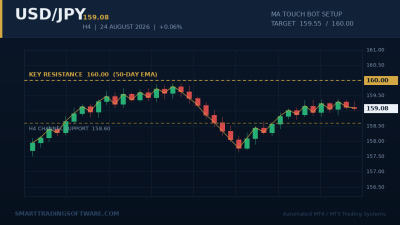
USD/CAD Compresses Inside a Falling Wedge Near 1.3696
The loonie pair is hovering at 1.36962 as of mid-May 2026, caught between a multi-week downtrend and an increasingly visible falling wedge structure on the daily chart. Since early April, USD/CAD has corrected steadily lower from the 1.3920 zone, but bears have failed to push the market through the critical 1.35418 floor — the 2026 lows. The result is a tightening range, with the daily RSI flat near 44 and the MACD slipping deeper into negative territory while the histogram begins to narrow. That divergence between price compression and decelerating downside momentum is exactly the technical fingerprint of a falling wedge nearing resolution.
For systematic traders, this is the kind of setup where a disciplined breakout strategy can outperform discretionary entries. A wedge target sits at 1.4234 on a confirmed upside breakout, while a clean break of 1.35418 would reopen the path toward 1.3200. The asymmetric reward profile favours preparation now, not reaction later.
Trading the Falling Wedge with a Trend Lines Bot
A falling wedge becomes tradeable the moment price closes above the upper descending trendline with confirmation from a momentum filter. Our Trend Lines Bot automates exactly this workflow on MetaTrader 4 and 5 — it draws and updates the wedge boundaries dynamically, detects the breakout candle, and routes the order through your broker without manual chart-watching.
Entry parameters for the long breakout
The upper wedge boundary currently projects into the 1.3738–1.3760 zone for the rest of May. A 4-hour close above 1.3760, ideally retested as support, is the highest-probability entry. Conservative traders can wait for a daily close above 1.3782 — that level cleared the 200-period moving average on the H4 chart in the most recent rejection and remains the key bull-confirmation threshold.
Stop loss and take profit zones
Place initial stops just below the most recent swing low at 1.3625, which sits inside the wedge and protects against false breaks. The first take-profit target aligns with the 1.3871 horizontal resistance, where price reversed sharply in late April. The measured wedge objective at 1.4234 is the swing target, giving a clean 1:3 risk-to-reward profile on a one-lot position scaled at the first target.
Short-side trigger if support breaks
If the wedge resolves bearishly instead, a daily close below 1.35418 invalidates the long bias entirely. The bot can be configured to flip directional bias automatically on that signal, with a downside objective at 1.3200 and a tighter stop above 1.3620.
Why Automation Helps in Range-Bound Wedge Setups
Compression patterns punish impatient traders. The wedge has been narrowing for six weeks, and the next genuine breakout will likely arrive on a single high-volume candle — possibly tied to the next Bank of Canada policy statement or a US CPI surprise. Manual traders watching screens through summer will tire, take partial fills early, or fade the move when it finally arrives. Algorithmic execution eliminates that fatigue.
For multi-timeframe confirmation, pair the trend-line breakout signal with our RSI Multi Time Frame Bot. It cross-checks RSI conditions on H1, H4, and the daily simultaneously, so a long signal only fires when momentum is aligned across at least two timeframes. That single filter alone has historically reduced false wedge breakouts on USD/CAD by a meaningful margin in our backtests.
Traders who prefer to validate the setup manually first can plot zones with our Support & Resistance Indicator, which auto-identifies the 1.35418, 1.3760, 1.3871, and 1.3920 levels as institutional pivots based on volume profile and historical reaction data.
Key Levels to Watch This Week
The map for the next two weeks is unusually clean. On the downside, 1.3625 is the intra-wedge support; below it, 1.35418 is the 2026 floor and a true line in the sand. On the upside, 1.3738–1.3760 is the wedge upper boundary, 1.3821 is the 200-period moving average resistance, and 1.3871 is the horizontal level that capped the April rally. A break beyond 1.3920 would mark a structural shift back into the broader 2025 uptrend channel.
The RSI sitting at 44 means there is no extreme to fade in either direction — the move when it arrives will come from a fresh catalyst, not from mean reversion. Volume on the breakout candle is the single most important confirmation signal.
Getting Started with USD/CAD Wedge Trading
If you want to position for the breakout without watching charts daily, the workflow is straightforward.
1. Install the Trend Lines Bot on your MetaTrader 4 or 5 terminal with a USD/CAD H4 chart open.
2. Configure the wedge boundaries by entering the recent swing highs (1.3920, 1.3871, 1.3782) and swing lows (1.35418, 1.3625) into the bot's level table.
3. Set entry confirmation to require a 4-hour candle close beyond the trendline plus a positive MACD histogram cross.
4. Apply a fixed stop at 1.3625 for long signals and 1.3620 for short signals, with the take-profit ladder set at 1.3871, 1.4050, and 1.4234.
5. Run the RSI Multi Time Frame Bot in parallel on the same chart as an entry filter.
6. Let the system run. Wedges resolve on their own schedule, not yours.
Questions about parameters for your specific account size or broker? Reach out via our contact page and our team will help configure the setup for your risk profile.