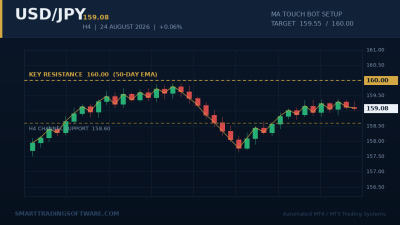
AUD/USD Slips to 0.7161 as 20-Day EMA Caps Recovery
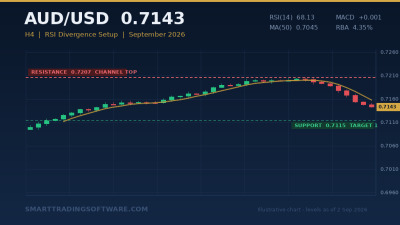
The Australian dollar has had a tough mid-May, drifting back to roughly 0.7161 against the greenback after stronger-than-expected US inflation reset rate-cut expectations for the second half of the year. The pair now sits just below the 20-day EMA at 0.7184, a dynamic resistance level that has acted as a magnet for sellers throughout the week. Until buyers reclaim that line on a daily closing basis, momentum is mildly bearish despite the broader uptrend that pushed AUD/USD toward a four-year high of 0.7277 earlier this month.
The fundamental backdrop is more constructive than the chart suggests. Markets are still pricing the possibility of an RBA hold-to-hike shift, while US CPI surprised to the upside and pushed Fed cut bets further out. That divergence keeps the medium-term bias for AUD/USD bullish, but only if price action confirms it. A daily close back above 0.7184 would do exactly that, opening the door to a retest of 0.7214–0.7277. A break below 0.7115, on the other hand, would expose the deeper 0.6945 support and flip the structure back into the bears' hands.
The CCI Reversal Strategy on AUD/USD
Conditions like these — a pair pinned between a near-term EMA cap and a defined support floor — are tailor-made for a Commodity Channel Index (CCI) reversal approach. The CCI measures how far price has stretched from its moving average; in forex, traders typically watch the ±200 thresholds rather than the textbook ±100 because currency pairs spike harder than equities and commodities. When the CCI crosses back inside the ±200 band, it signals that the extreme has been spent and a mean-reversion move is statistically likely.
On AUD/USD's current 4-hour chart, the CCI(14) has dipped into oversold territory below -200 twice during the slide from 0.7277. Each of those readings preceded a bounce of at least 35 pips. A disciplined CCI trader is not buying or selling the extreme — they are waiting for the snapback that confirms it.
Entry, Stop-Loss, and Take-Profit Parameters
A clean CCI long setup on AUD/USD right now would look like this:
Entry: Buy on the next bar after CCI(14) crosses back above -200 on the H4 chart, ideally with price holding above the 0.7140 swing low.
Stop-loss: 30–35 pips below entry, just under the 0.7115 horizontal support (the level that, if broken, invalidates the bullish thesis).
Take-profit 1: 0.7184 — the 20-day EMA. Scale out 50% of the position here.
Take-profit 2: 0.7214 — the lower band of the prior consolidation.
Take-profit 3: 0.7277 — the four-year high and key swing target.
Risk-reward: Roughly 1:3 to the final target, with two earlier scale-outs that lock in profit and reduce risk to zero.
A mirror-image short setup applies if AUD/USD breaks 0.7115 and CCI fails to recover from a fresh oversold print — that combination flags trend continuation rather than reversal, and the same risk framework is used with targets at 0.7050 and 0.6945.
Why Automation Matters for CCI Trades on the Aussie
The CCI works best when the trader can react to a cross within a single candle. Manually, that means staring at a screen for hours waiting for one bar to print — and AUD/USD tends to deliver its sharpest moves during the Asian-Sydney overlap when most European and US traders are asleep. This is exactly the problem the CCI Bot was built to solve. It monitors any selected pair around the clock, fires the entry the moment a valid CCI cross prints, and manages stop-loss plus the multi-stage take-profit ladder automatically.
For traders who prefer to layer CCI with a second confirmation signal, the RSI Divergence Bot is a natural companion. Running both simultaneously on AUD/USD lets you filter CCI crosses through RSI divergence, dramatically cutting false signals during ranging conditions like the current 0.7115–0.7184 box.
Before deploying any strategy live, it pays to know how it would have performed on the last few hundred bars of price action. The Indicators Tester lets you replay AUD/USD history at any speed, verify the CCI signal logic, and tune the period setting (14, 20, or longer) for the volatility regime you expect to trade.
Key Levels to Watch This Week
Whether you trade the setup manually or hand it to a bot, the lines on the chart are the same:
Resistance: 0.7184 (20-day EMA, first hurdle) · 0.7214 (prior consolidation lower bound) · 0.7277 (four-year high) · 0.7295–0.7308 (extension zone)
Support: 0.7140 (intraday swing low) · 0.7115 (horizontal pivot — bullish thesis invalidation) · 0.7050 (61.8% Fibonacci of the April-May leg) · 0.6945 (deeper structural support)
The week's economic risk events matter too. Australian wage price index data and the RBA minutes can both jolt the Aussie, while US retail sales and the next round of Fed speak will dictate dollar direction. CCI bots are insensitive to news in the sense that they trade what price does, not what news says — but spreads widen around releases, so most operators schedule a brief no-trade window around the top-tier prints.
Getting Started with the AUD/USD CCI Setup
Putting this strategy into practice takes only a few minutes:
1. Install the CCI Bot on your MT4 or MT5 platform and attach it to the AUD/USD H4 chart.
2. Configure the CCI period to 14 and the overbought/oversold thresholds to +200 / -200 for forex-grade sensitivity.
3. Set the stop-loss buffer to 35 pips and load the 0.7184 / 0.7214 / 0.7277 levels as your three take-profit targets.
4. Backtest the configuration on the last 12 months of AUD/USD data using the Indicators Tester and confirm the equity curve before going live.
5. Optionally enable the RSI Divergence Bot as a confirmation filter to skip CCI crosses that lack momentum support.
6. Start on a micro-lot account, monitor the first few trades, then scale position size once the bot's behaviour matches your expectations.
AUD/USD's current setup is a textbook CCI reversal scenario — well-defined support, a clear EMA ceiling overhead, and a fundamental story that supports the bullish recovery if buyers can reclaim 0.7184. If you'd like help configuring the CCI Bot for your account size, timeframe preference, or risk tolerance, our team is happy to walk you through it. Reach out via the contacts page and we'll get you up and running before the next Aussie session opens.