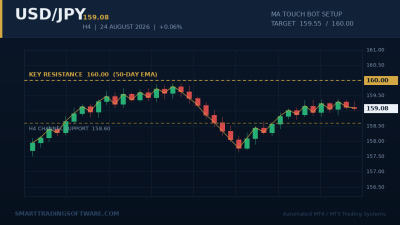
AUD/USD Holds 0.7089 Support as Bulls Eye 0.7185 Breakout
The Australian dollar is once again testing the patience of trend traders. As of late April 2026, AUD/USD is trading just above 0.7089, where the 20-period exponential moving average has lined up with a multi-week ascending trendline. The daily technical scorecard remains constructive, with most moving averages flashing buy signals and the RSI hovering around 57 — firmly in bullish territory but not yet overbought. With April historically being the strongest month of the year for the Aussie (averaging a 1.2% gain), traders are watching the 0.7185 high closely as the next decisive resistance.
The setup is one that recurs on the H4 and daily charts of AUD/USD throughout each year: a slow grind higher into prior swing resistance, a brief shake-out, then either a clean breakout or a return to the EMA. Rather than guess which scenario plays out, automated traders are leaning on rule-based systems that can monitor multiple price interactions with the trendline and act the moment a confirmed breakout occurs.
The 0.7089 to 0.7185 Trading Strategy
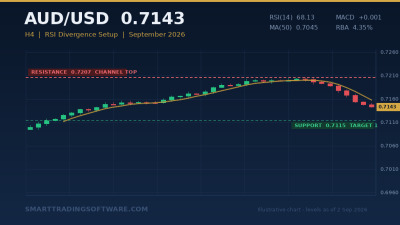
The current AUD/USD chart presents a textbook compression between dynamic support and horizontal resistance. The 20-day EMA at 0.7089 is acting as an upward-sloping floor, while 0.7185 — the highest print of the year — caps the upside. A confirmed breakout through 0.7185 opens the door to 0.7200 (psychological), and beyond that the multi-year high at 0.7222. A failure at the trendline, on the other hand, would expose the round number at 0.7000 and potentially shift the H4 structure to a corrective phase.
Long Entry Parameters
For the bullish breakout scenario, the cleaner setup waits for a 4-hour candle to close above 0.7185 with above-average volume. Aggressive traders may consider stop-orders just above the 0.7188 level, while more conservative traders can wait for a retest of broken resistance turned support around 0.7180. The stop-loss belongs below the EMA cluster at 0.7065, giving the trade roughly 120 pips of breathing room. First take-profit sits at 0.7200, second at 0.7222, and a runner can be left toward 0.7280 — 0.7300 if momentum extends.
Short Entry Parameters
If price rejects 0.7185 with a strong bearish reversal candle and breaks 0.7089 to the downside, a short setup activates. Entry on the H1 close below 0.7080, with a stop above 0.7140. Targets at 0.7035 and 0.7000, with a final objective at 0.6960 should the broader pullback take hold.
Why Automated Execution Improves Trendline Strategies
Trendline trades are notoriously sensitive to execution quality. A few minutes of hesitation around a clean H4 close can be the difference between catching a 100-pip move and entering at the worst possible price. This is the precise gap that the Trend Lines Bot was built to close. It draws and validates the dynamic support line in real time, monitors candle closes against the configured resistance, and fires the order with millisecond latency the moment confirmation criteria are met — no second-guessing, no missed bars.
For traders who prefer to react to horizontal levels rather than dynamic ones, the Support & Resistance Bot provides a complementary toolkit. It auto-detects key levels like 0.7185, 0.7089, and 0.7000 across multiple timeframes and lets you specify whether to trade the bounce or the breakout. Combined with the underlying Support & Resistance Indicator, the workflow becomes fully systematic: the indicator visualises the structure, the bot executes the plan.
Key Levels to Watch on AUD/USD
The chart map for the next two to three weeks is straightforward. On the upside, 0.7185 is the gateway to 0.7200 and the year-to-date high at 0.7222. A daily close above 0.7222 would open structural targets at 0.7280 and the long-term resistance band near 0.7300. On the downside, the 20-day EMA at 0.7089 is the first line of defence; a daily close below would put 0.7035 and the psychological 0.7000 in play. A sustained break of 0.7000 would invalidate the broader bullish bias and shift attention to 0.6960 and 0.6900.
Macro context still matters. Policy divergence between the RBA and the Fed remains a key driver, and risk-on sentiment in commodities — particularly iron ore — tends to support the Aussie when global growth expectations stabilise. Q2 2026 carries elevated headline risk, so position sizing matters as much as level selection.
Getting Started With Automated AUD/USD Trading
If you want to deploy the strategy described here without sitting in front of the screen all day, the workflow is straightforward:
- Backtest your trendline parameters and confirmation rules using the Indicators Tester on at least two years of H4 AUD/USD data so you understand the win rate and drawdown profile before going live.
- Install the Trend Lines Bot on a demo MT4 or MT5 account, configure the 0.7185 resistance and 0.7089 EMA support, and validate execution in current market conditions.
- Once forward-test results match backtest expectations, switch to a live account using a small position size and gradually scale as confidence builds.
- Layer in the Support & Resistance Bot as a second strategy on the same chart for additional opportunity coverage at static levels.
Whether the AUD/USD breakout above 0.7185 plays out cleanly or the pair is dragged back to 0.7000, having a tested, automated rulebook removes the emotional cost of either outcome. To discuss which configuration fits your account size and risk tolerance, contact the Smart Trading Software team and we will help you tune the system for the current Aussie market.