XRP Holds the Line at $1.42 as Buyers Defend the $1.38 Floor
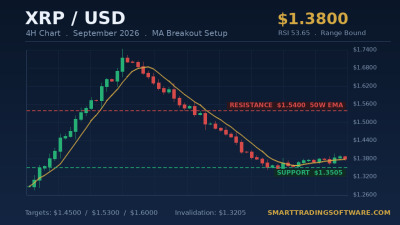
XRP is trading at $1.4213 on April 21, 2026, edging up into the upper third of a tight consolidation band that has defined the token for most of the month. After a messy Q1 in which Ripple's native asset slipped under the psychological $1.20 mark, buyers have clearly drawn a line between the $1.38 support floor and the $1.43 resistance ceiling, a range that has now contained more than a dozen daily closes. Momentum has quietly improved: the 20-day and 50-day moving averages are flattening under price, the MACD has ticked marginally positive for the first time since February, and the 50% retracement of the last downswing at $1.39 continues to act as a spring for dip-buyers.
The broader picture is still cautious. The 200-day moving average sits high above at roughly $1.88 and remains the structural bull/bear line for the year. But inside the current micro-structure, XRP is behaving exactly like a range-bound instrument — and that is a tradeable opportunity. Rather than guessing direction, disciplined traders are treating every touch of $1.38 as a long setup and every rejection near $1.43 as a short, until the range definitively breaks.
The Range Strategy: Trade Both Sides Until the Breakout
Range trading on XRP right now is about selling the top and buying the bottom of the $1.38–$1.43 channel with tight, mechanical risk. The strategy assumes neither side is ready to commit: bulls cannot clear $1.43 cleanly, bears cannot break $1.38 with conviction, and intraday volatility is compressing. In that environment, mean-reversion setups outperform trend-following signals until price escapes the box.
Long Setup Near $1.38
Enter long on a confirmed bounce from the $1.38–$1.39 support zone, ideally with a bullish reversal candle on the 1-hour or 4-hour chart. Place the stop-loss at $1.3650, just below the recent swing low and clear of typical wick noise. First take-profit at $1.4180, the upper boundary of the range; a secondary target at $1.4480 if the range breaks up on volume. Risk-to-reward on the first leg is roughly 1:2.2.
Short Setup Near $1.43
Short on rejection at $1.4280–$1.4320 after a clear failure to close a 1-hour candle above $1.43. Stop-loss at $1.4480, above the breakout trigger. First take-profit at $1.3920, near the 50% retracement; secondary target at $1.3750 if selling accelerates through the floor. Again, around a 1:2 reward profile per unit of risk.
Invalidation
The strategy stops working the moment XRP posts a 4-hour close outside the range on above-average volume. A close above $1.43 shifts bias toward the next resistance at $1.50. A close below $1.38 exposes $1.33 and then $1.20 on the downside.
Why a Support & Resistance Bot Beats Manual Range Trading
Range setups look simple but they demand precision most traders cannot deliver manually. Prices wick, alerts fire at 3 a.m., and emotional bias creeps in after two losing trades. Algorithmic execution removes all three frictions. The Support & Resistance Bot (€211) was designed for exactly this type of structure: it identifies horizontal S/R zones automatically, waits for confirmation at the levels you configure, and places orders with your pre-defined stop and target — no hesitation, no override.
Layered on top of that, the Support & Resistance Indicator (€63) plots the active S/R grid cleanly on your chart so you can eyeball confluence with your own analysis before letting the bot trade. And before deploying real capital, the Indicators Tester (€155) lets you replay XRP's last 90 days and see exactly how the range strategy would have performed across different stop-loss widths and confirmation filters.
Key Levels to Watch This Week
Short-term support rests at $1.3900 (50% retracement) and $1.3800 (range floor). A clean break below opens $1.3300 as the next liquidity pocket. On the upside, sellers sit at $1.4300 (range cap) and $1.5000 (round-number magnet and prior rejection zone). Above $1.50, the path opens toward the 200-day MA near $1.88, which is the real bull/bear line for the year.
MACD is hovering just above zero, the relative strength index is in the mid-50s, and volume has been declining — all classic signals of a range that is coiling. The longer this consolidation holds, the sharper the eventual breakout tends to be, so a mechanical plan that is ready to flip from range mode to breakout mode is the edge.
Getting Started with the XRP Range Setup
- Install the Support & Resistance Bot on your MetaTrader 4 or 5 platform and attach it to the XRP/USD 1H chart.
- Configure the active range to $1.38–$1.43 with confirmation filters set to at least one bullish/bearish reversal candle plus a minimum wick ratio.
- Overlay the Support & Resistance Indicator to visually confirm the bot's zones and adjust if you see confluence with Fibonacci or prior pivot levels.
- Run the setup through the Indicators Tester on the last 60–90 days of XRP data to stress-test stop widths and validate expectancy before going live.
- Go live with a conservative position size — 1% account risk per trade is plenty in a compressed range — and let the bot mechanically execute both sides until the range breaks.
Range-bound markets reward patience and automation far more than they reward conviction. If you would like help configuring the Support & Resistance Bot to your specific XRP setup, or want a walkthrough of the Indicators Tester results before committing capital, reach out via our contact page and our team will get back to you within one business day.