Ethereum Stalls Near $2,417: Why the $2,586 Resistance Is the Next Battleground
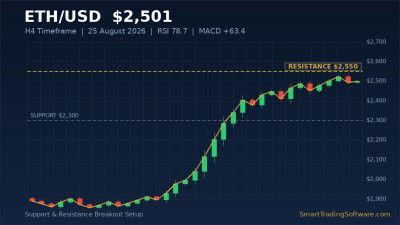
Ethereum (ETH/USD) is trading around $2,417 as of April 23, 2026, grinding higher after the February flush that dragged the market toward $1,800. The chart is no longer in free-fall, but it is also not in confirmed breakout mode. Price keeps stacking higher lows above the $2,106-$2,176 support shelf, yet every push into the $2,350-$2,400 zone has been met with supply. Daily RSI sits at roughly 56.36, a neutral reading that leaves room for upside but demands a catalyst to clear the $2,586 ceiling.
Under the hood, the tape is genuinely mixed. Across the standard dashboard of technical studies, traders are looking at 17 bullish signals versus 12 bearish ones, while the April forecast from independent models still projects an average trading range of $2,254 to $2,656. That asymmetry, a slight bullish tilt inside a clearly defined channel, is exactly the kind of environment where mechanical, rules-based strategies tend to outperform discretionary trading.
The RSI Divergence Playbook for ETH's Current Range
The cleanest setup on the ETH 4-hour chart right now is a classic RSI divergence framework wrapped around the $2,350 pivot. Price has been knocking on that level for ten sessions while RSI has posted lower highs each attempt, a textbook bearish divergence inside a longer-term neutral trend. If you flip the same template to the downside, the $2,106 swing low printed with a higher RSI reading than the $1,890 low from February, which is a bullish divergence that has so far held.
Either leg of this pattern is tradeable, but the edge lives in discipline: waiting for confirmation, sizing correctly, and getting out when the divergence invalidates. That is where the RSI Divergence Bot earns its keep. It watches for regular and hidden divergences on any timeframe, filters them against a configurable ATR-based volatility gate, and executes only when both the price pivot and the RSI pivot line up.
Long Setup Parameters
For a long biased on the bullish divergence at $2,106, a reasonable plan is: entry on a 4-hour close back above $2,300 after a dip, stop-loss below $2,090, first take-profit at $2,400 (cover 50%), second take-profit at $2,586. That gives a risk-to-reward close to 1:2.3 on the full position while covering the most obvious structural levels.
Short Setup Parameters
For a fade of the $2,400 rejection zone based on bearish RSI divergence: entry on a 4-hour close back below $2,380, stop-loss above $2,410, take-profit 1 at $2,300, take-profit 2 at $2,180. Keep position size conservative because the $2,586 resistance has not actually been tested yet, and a squeeze through it would invalidate the entire short thesis.
Why Automation Beats Staring at the Chart
ETH does not respect your sleep schedule. A divergence that prints at 03:00 UTC is the same divergence you spot at 15:00, but most discretionary traders miss half of them. Automated execution solves three specific problems in this range-bound tape. First, it removes the temptation to widen stops when price flirts with the invalidation level. Second, it enforces consistent position sizing across every trade, so one bad impulse cannot blow out the account. Third, it lets you run the same rules across multiple crypto pairs without context-switching.
For traders who prefer a purpose-built crypto engine, the Crypto Bot is tuned specifically for BTC, ETH, and large-cap altcoins. It ships with preset risk profiles for high-volatility sessions and a regime filter that throttles trading during low-liquidity hours. If you want to see how either bot would have performed on actual ETH price history before risking real capital, the Indicators Tester lets you backtest strategy logic against multi-year tick data with full stats on drawdown, profit factor, and recovery factor.
Key Levels to Watch This Week
The levels that matter for the next several sessions are narrow enough to mark on a single line. Support is layered at $2,300 (recent pivot), $2,176 (rising trendline from the $1,800 bottom), and $2,106 (major structural floor). Below $2,100, the bullish divergence case is off the table and $1,890 comes back into play. Resistance starts at $2,400, with the real test at $2,586. A daily close above $2,586 opens the door to $2,800 and a push back toward the April average forecast of roughly $2,656.
One quiet but important tell: the gap between price and the 50-day moving average has compressed into a narrow band. Mean-reversion reads cleanly in that configuration, which is why divergence-based systems tend to outperform trend-following systems until ETH chooses a direction. The MA Distance Indicator plots this deviation directly on the chart and alerts when stretch expands beyond a configurable sigma, which is a pragmatic way to know when the range is actually breaking.
Getting Started With a Rules-Based ETH Strategy
If you want to trade this setup without improvising every session, the path is straightforward:
1. Decide which side of the divergence you want to take first. If you are in profit on spot ETH and want to hedge, the short-side fade of $2,400 is likely more useful. If you are building a position, the long side off $2,106-$2,176 is the cleaner structural trade.
2. Download and install the RSI Divergence Bot or the broader Crypto Bot, depending on whether you want one tight setup or a multi-pair engine.
3. Load the last 24 months of ETH/USD data into the Indicators Tester and run the strategy with your chosen stop, target, and position-size rules. Look for profit factor above 1.3 and max drawdown you can actually stomach.
4. Deploy on a demo account for at least two full weekly cycles before going live. The crypto market's weekend behavior matters more than most backtests suggest.
5. Set alerts on $2,586 (breakout) and $2,106 (breakdown) so you know which regime you are in before the bot opens its next position.
Range-bound ETH punishes traders who chase and rewards those who wait for confirmed divergences at structural levels. If you have questions about configuration, broker compatibility, or which product fits your account size, contact our team and we will point you to the right setup for your goals.