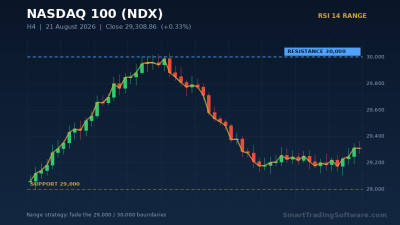
Nikkei 225 Tests All-Time Highs Near 59,600
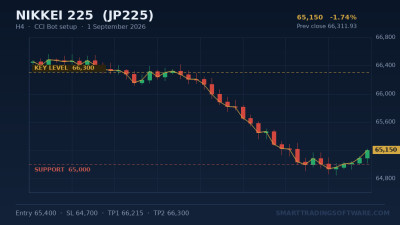
The Nikkei 225 has printed fresh record highs this week, closing at 59,606 on April 16, 2026 after a 2.53% rally driven by optimism around a potential de-escalation in the Middle East and sustained weakness in the Japanese yen. Traders are now watching a critical confluence: a vertical run into the 60,000 psychological barrier while momentum oscillators quietly flash warning signals. The setup is classic bearish divergence territory — a pattern that has historically produced high-probability short-term reversals on Japan's flagship index.
With the BOJ still telegraphing a measured hike path and exporters benefiting from a weak yen, the fundamental backdrop remains constructive. But technically, price is extended well above its 50-day moving average, and the weekly CCI has failed to confirm the latest higher highs. For swing traders this is the moment where discipline matters more than conviction — and where a rules-based CCI divergence framework can separate a well-timed pullback entry from a chase at the top.
Why CCI Divergence Works on Index Breakouts
The Commodity Channel Index measures how far price has deviated from its statistical mean. Readings above +100 signal an overbought extension; readings below -100 signal oversold. On the Nikkei daily chart, CCI pushed above +200 during the March rally from 51,000 but has failed to print a new extreme on each subsequent push higher. Meanwhile, price has climbed roughly 16% over the same window. That mismatch — price making higher highs, CCI making lower highs — is textbook bearish divergence.
The 60,000 level matters for three reasons. First, it is a round-number psychological magnet where institutional stops cluster. Second, monthly forecasts place an upper Nikkei band near 63,200–63,600 for April, meaning a rejection from 60,000 would fit the expected range volatility. Third, prior rejections at similar extensions (the 58,850 print on February 27) led to multi-day pullbacks into the rising 20-day MA.
Entry, Stop-Loss and Take-Profit Parameters
A rules-based CCI divergence short entry on the Nikkei 225 can be structured as follows:
Entry trigger: Short on a candle close below 59,300 after CCI crosses back under +100 on the 4-hour chart, confirming loss of bullish momentum at the 60,000 zone.
Stop-loss: 60,350 — just above the psychological barrier and the projected April high envelope. This gives the trade roughly 1,050 points of risk.
Take-profit 1: 57,800 — the rising 20-day moving average. Scale out 50% here.
Take-profit 2: 55,600 — the cluster of prior support and the March congestion zone, offering roughly 3.5R against initial risk.
How Automation Removes the Emotional Trap at Record Highs
Shorting at all-time highs is psychologically hard. Traders either freeze, chase, or size down to the point that the setup stops being worth trading. Automation solves this by turning the checklist into code. The CCI Bot scans the market for divergence conditions, validates the CCI extreme level, and executes the entry with the predefined risk parameters — no hesitation at the round number.
For confirmation, the MA Distance Indicator measures how far price has stretched from the 50-day and 200-day moving averages. On the Nikkei, a reading above 2 standard deviations has preceded most meaningful pullbacks in the last 18 months. Combining the two — CCI divergence plus MA distance extension — produces a high-conviction short-side filter that is hard to replicate manually in real time.
For traders who prefer the long side of the trend, the Trend Lines Bot can manage pullback buys into the 57,800 and 55,600 zones, treating any CCI reset as an opportunity to re-enter the larger uptrend rather than fight it.
Key Levels to Watch This Week
The technical map on the Nikkei 225 is unusually clean right now. Resistance: 60,000 (psychological round number and projected April upper band), then 63,200 (April forecast ceiling) and 65,000 (longer-term Fibonacci extension from the 51,000 base). Support: 57,800 (rising 20-day MA), 55,600 (March congestion and prior resistance now flipped), 54,300 (short-term bullish acceleration pivot) and 53,370 (the line in the sand for the bullish structure — a weekly close below would invalidate the current uptrend).
As long as price holds above 53,370, dip buys remain the higher-probability strategy on timeframes of 4 hours and above. Below 53,370, the character of the market changes and the bias would flip to selling rallies. The CCI divergence short laid out above is a tactical countertrend setup sized accordingly — not a trend reversal call.
Before You Trade It Live: Validate the Setup
Historical behavior is the best filter for any index strategy. The Indicators Tester allows you to replay CCI divergence signals on Nikkei 225 data from the last several years, including the 2023 and 2024 breakout episodes when similar 60,000-style psychological levels triggered multi-day rejections. Backtesting before deploying real capital is non-negotiable, especially when shorting into a trending index at its highs.
Getting Started with the Nikkei 225 CCI Divergence Setup
To trade this setup on a live or demo MetaTrader 5 account, the workflow is straightforward:
- Install the CCI Bot and attach it to the Nikkei 225 (JP225) 4-hour chart.
- Configure entry threshold at CCI cross below +100 and arm the short-side divergence module.
- Layer the MA Distance Indicator on the daily chart as a confirmation filter — only take shorts when distance exceeds the 2-sigma band.
- Run a 3-year lookback with the Indicators Tester to validate expectancy before going live.
- Size positions so that the 1,050-point stop represents no more than 1% of account equity.
- Monitor the 60,000 and 53,370 levels — these are the two prices that define whether the short setup is valid or whether the trend thesis has changed.
Markets rarely offer clean technical setups at round-number extremes. When they do, the winning edge tends to be systematic execution rather than discretionary courage. If you want help configuring any of these tools for your Nikkei 225 trading plan, get in touch with our team — we build and tune automation for exactly this kind of environment.