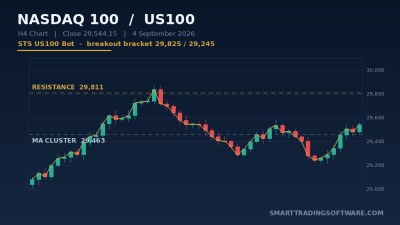
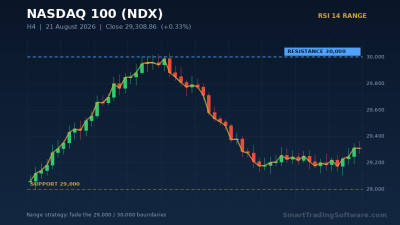
NASDAQ 100 Pulls Back to 29,481 After Tagging All-Time Highs Near 30,000
The NASDAQ 100 (NDX) is trading around 29,481, just below the psychological 30,000 zone and the recent all-time high printed on May 14, 2026. After weeks of vertical extension driven by AI mega-caps and resilient earnings, the index has slowed into a tight consolidation between roughly 29,000 support and 29,700 resistance, with traders eyeing whether bulls can absorb supply at the highs or whether a deeper pullback toward the rising 50-day EMA is on the cards.
Daily structure still favors the upside. NDX continues to hold above its 20, 50, and 200-day moving averages, the higher-high/higher-low sequence remains intact, and pullbacks since April have been shallow and quickly bought. That said, a faint bearish divergence on the MACD histogram and the recent rejection from 29,800 are reasons not to chase strength blindly. This is the kind of mature uptrend where letting the chart come to you – and letting an algorithm pull the trigger – tends to outperform impulsive clicks.
How to Trade the 30,000 ATH Breakout Setup
The trade plan is built around a classic trend-continuation logic: wait for a pullback into rising moving-average support, demand confirmation, and only commit on a clean break of the prior swing high. The setup keeps you out of choppy mid-range price action and only engages when momentum is firmly on the long side.
Entry: Pullback into the 21 EMA, Break of Range High
Look for price to retrace into the 29,150 – 29,250 zone, which currently aligns with the rising 21-period EMA on the daily chart and a recent demand pocket. A bullish reversal candle (engulfing, hammer, or inside-bar break) in that zone is the trigger, followed by a stop entry just above the local swing high near 29,720. This filters out failed bounces and confirms that buyers are willing to lift offers at resistance.
Stop-Loss: Below the EMA Cluster
Place the protective stop below the EMA cluster and the prior pullback low, around 28,840. That keeps risk roughly 1.5% from entry – tight enough to deliver a high R-multiple, wide enough to avoid noise from the typical 1-1.5% intraday range NDX has been printing in May.
Take-Profit: 30,000 Psychological and 30,450 Measured Move
Scale out one-third at the 30,000 round number, where the most obvious profit-taking will sit, and let the rest run toward the measured move from the prior consolidation at roughly 30,450. A trailing stop under each new daily higher low keeps the runner alive if NDX extends through 30,500 toward 31,000.
Why Automation Matters at the ATH
Trading just below an all-time high is psychologically brutal. Every red candle feels like the top, every green candle feels like FOMO. That is exactly the environment where rule-based execution outperforms discretion. A bot doesn't blink at a fast spike, doesn't flatten early because a news headline scared it, and doesn't double its size after two winners. It just waits for the conditions and pulls the trigger.
For this kind of trend-following NDX setup, the Trend Lines Bot is purpose-built. It uses moving-average alignment plus structural trend lines to qualify trades, so it only engages when the daily uptrend is intact and price is pulling back into a defined area – exactly the logic we just described, but executed mechanically across every session. If your edge comes more from clean swing structure than from indicators, the Price Action Bot reads candle patterns, support/resistance flips, and impulse-correction sequences without the noise of subjective drawing.
Traders who prefer to stay alert for exhaustion signals near the ATH should pair the trend bot with the MA Distance Indicator. It quantifies how stretched price is from the 20 and 50 EMA, flagging conditions where the long side is overextended and the next swing is likely a mean-reversion pullback rather than a vertical breakout.
Key Levels to Watch on NDX This Week
The decision zones for the next directional move are well-defined:
Resistance: 29,720 (recent swing high), 30,000 (psychological + ATH), 30,450 (measured-move projection), 31,000 (extended target on a clean breakout).
Support: 29,150 – 29,250 (21 EMA + demand pocket), 28,840 (invalidation), 28,300 (50-day EMA), 27,500 (April consolidation high, last line of trend defense).
As long as daily closes stay above 28,840, the trend-continuation thesis is intact. A daily close below 28,300 would flip the structure and shift attention to a deeper retracement toward 27,500, where the next high-quality buy-the-dip zone sits.
Backtest Before You Deploy
No trend system survives every regime. The 2022 NDX bear market would have shredded a naive breakout bot, and the chop of August 2023 punished anyone trading every EMA pullback. Before risking live capital on the 30,000 breakout, run the strategy through the Indicators Tester on at least three years of NDX 1-hour and daily data. You want to see how the system performs in low-volatility chop, sharp pullbacks, and earnings-driven gaps – not just in the friendly trend you can see on the screen today.
Getting Started
To put this setup to work on the current NDX structure:
1. Pick your execution engine: Trend Lines Bot if you want EMA + trendline confirmation, or Price Action Bot if you trade clean candle structure.
2. Configure the bot for NDX/NAS100 (or NQ futures CFD) on the H1 or H4 timeframe and set the daily trend filter to "long-only" while NDX trades above its 50-day EMA.
3. Add the MA Distance Indicator to your chart and use it as a no-trade filter when price is more than two ATRs above the 20 EMA.
4. Run a 36-month backtest in the Indicators Tester on NDX H1 data, then forward-test on a demo account for two weeks before going live.
5. Risk no more than 0.5%-1% of equity per trade and cap concurrent NDX exposure at one open position to avoid stacking correlation risk on a single index.
Need help wiring this setup into your existing MetaTrader workflow, or want a custom risk profile for your account size? Get in touch with our team and we'll help you get the trend-following stack configured and tested before the next push toward 30,000.