DAX 40 Reclaims 24,700 as Geopolitical Risk Premium Unwinds
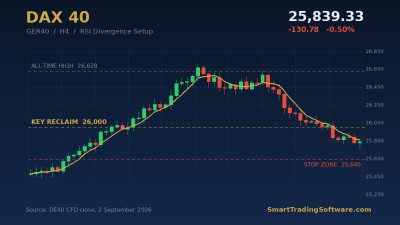
The German DAX 40 index surged 548 points or 2.27% on Friday, closing at 24,702 — its highest level since late February — after Iran announced the full reopening of the Strait of Hormuz to commercial shipping. The move unwound a chunk of the geopolitical risk premium that had been weighing on European equities, and it has brought the 26,000 psychological barrier squarely back into view for traders looking at the next leg higher.
The index is now trading cleanly above the pivot point at 23,147 and above the classic R1 resistance at 24,431, which has flipped into first-line support. The path toward R2 at 26,181 is technically open, though the tape is likely to remain choppy as equity markets digest the combination of ECB easing expectations, a mixed earnings season for German exporters, and ongoing uncertainty around US tariff policy. Analysts at Capital.com and IG have both flagged 26,000 as the next key test, while RoboForex pegs 22,080 as the line in the sand below which the medium-term bullish structure would be threatened.
Price Action Breakout Strategy at the 24,700 Pivot
With the DAX now pressing against the upper edge of a multi-week consolidation, the cleanest opportunity for swing traders is a price-action breakout setup anchored to the 24,700 pivot. The idea is simple: wait for a daily close above 24,900, confirm with a retest of broken resistance, and then ride the move toward the 26,000 cluster where heavy option gamma is expected to sit. This kind of setup rewards patience, because the initial breakout candle is rarely the one that delivers the full move — confirmation through a bullish engulfing or pin-bar retest is typically a higher-probability entry.
Entry, Stop-Loss, and Take-Profit Parameters
For a long setup on the 4H or daily chart:
Entry: 24,900 on daily close confirmation, or 24,720-24,750 on a retest of the Friday breakout zone with a bullish reversal candle. Stop-Loss: 24,380 — just below the prior R1 resistance that has flipped to support. This gives a roughly 350-400 point risk buffer. Take-Profit 1: 25,400 (mid-channel resistance). Take-Profit 2: 26,000 (psychological barrier and option cluster). Take-Profit 3: 26,180 (R2 pivot). A scaled exit at each level helps lock in risk-reward ratios north of 1:3 on the initial tranche.
Traders who prefer mean-reversion rather than chasing strength can instead fade rallies into 25,400-25,500 with stops above 25,700, targeting a pullback to 24,700. Either side works, but discipline around the stop matters more than the direction.
Why Automation Matters for Index Volatility
Indices like the DAX rarely give clean intraday signals during news-driven sessions, and manual execution tends to suffer during the first and last 90 minutes of the cash session when volatility spikes. A properly backtested bot enforces the plan without blinking. The Price Action Bot at €450 is purpose-built for this kind of structural breakout setup, scanning for engulfing patterns, pin bars, and inside-bar breaks across configurable timeframes and executing only when the confluence criteria are met.
For traders who prefer oscillator-based filters, the CCI Bot at €250 adds a Commodity Channel Index overlay that helps filter false breakouts by requiring CCI confirmation above the +100 zone before entries are triggered. Pairing the two on the same account — one trading structure, the other trading momentum — creates meaningful strategy diversification without doubling directional exposure.
Key Levels to Watch This Week
Support: 24,431 (flipped R1), 23,800 (April pivot), 23,147 (classic pivot), 22,080 (bearish trigger). Resistance: 24,900 (breakout confirmation), 25,400 (mid-channel), 26,000 (psychological), 26,181 (R2). A daily close back below 24,431 would neutralize the bullish setup and shift the bias back toward range-trading the 23,800-24,700 zone. Conversely, sustained acceptance above 25,000 with declining ATR would open the door to a measured move toward 26,500.
Volume profile on the XETR session shows a clear point of control near 24,300, which reinforces the idea that 24,400 is the level bulls need to defend on any pullback. Watch the DAX futures (FDAX) for early signals during US hours — a close above Friday's high of 24,760 in the overnight session would be an early tell for continuation.
Getting Started with the Setup
For traders who want to deploy this strategy in a disciplined, automated way, here's the step-by-step approach:
1. Download MetaTrader 5 and connect it to a DAX-enabled broker with sub-1-point spreads during cash hours. 2. Install the Price Action Bot and configure the entry filter for the 4H timeframe with confirmation on the daily close. 3. Set stop-loss at 24,380 and take-profit ladders at 25,400 / 26,000 / 26,180 with a partial-close rule at each level. 4. Add the MA Distance Indicator at €25 to monitor how far price has extended from the 20 EMA — a useful filter to avoid chasing extended moves. 5. Before going live, validate every parameter on 12-24 months of DAX history using the Indicators Tester at €155 to quantify win rate, drawdown, and average R-multiple.
The DAX is rarely boring, and the next few weeks — with ECB meetings, German IFO data, and earnings season overlapping — should offer several opportunities to trade this structure. The key is having the tools ready before the move, not after.
Have questions about deploying this setup on your own account, or want help tuning parameters for your preferred broker? Get in touch with our team and we'll walk you through it.