DAX 40 Holds Near 23,800 as Tariff Tensions Reshape European Markets
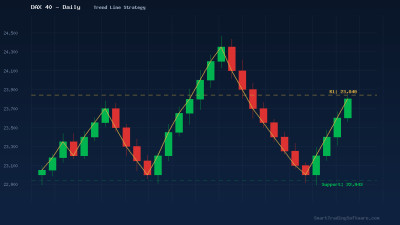
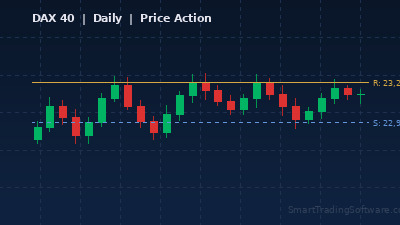
The DAX 40 closed the week at 23,804, sitting just beneath a key resistance zone while traders weigh the growing impact of US-EU trade tensions on German exporters. With car exports to the United States already down nearly 15% under the revised tariff agreement, the index finds itself balancing between resilient domestic earnings and external headwinds from a 15% baseline tariff on European auto imports. The November low at 22,943 continues to anchor the downside, while the 24,000–24,500 band remains the target for bulls looking to reclaim record territory.
This setup creates a well-defined trading range that suits automated trend-following strategies — and the current price action is offering clear signals for both breakout and mean-reversion approaches.
Trading the 22,900–24,500 Range with Moving Average Trend Lines
The DAX has been carving out a consolidation channel between 22,900 and 24,500 since early March. Within this range, price has repeatedly respected the 50-period and 200-period moving averages on the daily chart, making these dynamic levels ideal for automated entry and exit signals.
A trend line strategy works particularly well in this environment because the index is rotating between well-defined support and resistance rather than trending in a single direction. Each touch of the lower boundary near 22,943–23,000 has produced a bounce, while rallies toward 24,000 have met selling pressure from institutional profit-taking.
Entry Parameters for Long Positions
Look for the DAX to pull back toward the 23,000–23,100 zone, which aligns with both the November low and the ascending 50-day moving average. A bullish crossover of the 10-period EMA above the 20-period EMA near this level confirms momentum is shifting upward. The Trend Lines Bot can detect these moving average crossovers automatically and execute entries without delay, removing the emotional hesitation that often causes traders to miss the optimal entry window.
Exit and Risk Management
Set initial take-profit targets at 23,840, which corresponds to the R1 pivot level, and a secondary target at 24,400 near the upper boundary of the range. Place stop-losses 80–100 points below entry, ideally beneath the 22,900 structural support. This gives a risk-reward ratio of approximately 1:2.5 on the first target and 1:4 on the extended target. For short entries near resistance, the setup reverses — enter near 24,400–24,500 with stops above 24,650 and targets back toward 23,500.
Why Automation Matters in Tariff-Driven Volatility
Trade policy headlines move markets in seconds. When the EU announced potential countermeasures to US auto tariffs in late March, the DAX dropped over 400 points in a single session before recovering half the move by the close. Manual traders who stepped away for lunch missed both the entry and the reversal. An automated system running a RSI Divergence Bot would have identified the oversold divergence at the intraday low and triggered a long entry before the bounce accelerated.
The Moving Average Distance Indicator adds another layer of precision by measuring how far price has deviated from its mean. During the March sell-off, the indicator flagged an extreme reading when the DAX traded more than 3% below its 200-day MA — a condition that historically precedes a snapback rally within five sessions. Combining this with the trend line bot creates a system that both identifies the opportunity and executes on it.
Key Levels to Watch This Week
The immediate battle is at 23,840, the classic R1 pivot. A daily close above this level opens the path to 24,000 and then 24,431, the next pivot resistance. On the downside, 23,147 acts as the pivot point, and a break below 23,000 would bring the pessimistic scenario into play with a target near 22,080. The 21,145 level marks the worst-case support if a full EU-US trade escalation materializes.
ECB policy provides a potential catalyst: markets are pricing in another 25 basis point cut in the coming weeks, which would support equity valuations and likely push the DAX toward the upper end of the range. Watch for any official commentary from ECB board members as a trigger for directional moves.
Getting Started with Automated DAX Trading
1. Define your range boundaries. Use the 22,943 low and 24,500 high as your structural framework for the current cycle.
2. Set up the Trend Lines Bot on the DAX 40 CFD with 10/20 EMA crossover settings. Configure it for the H4 timeframe to filter out intraday noise while still capturing multi-day swings.
3. Add the MA Distance Indicator to your chart to monitor mean-reversion signals. Set alerts for readings beyond 2 standard deviations from the 200-day average.
4. Backtest the setup using the Indicators Tester on at least 12 months of DAX data to validate win rate and drawdown before going live.
5. Start with a conservative lot size — 0.5% risk per trade — and scale up only after the strategy proves consistent over 20 or more trades.
For personalized help configuring these tools for DAX trading, reach out through our contact page and our team will assist with setup and optimization.